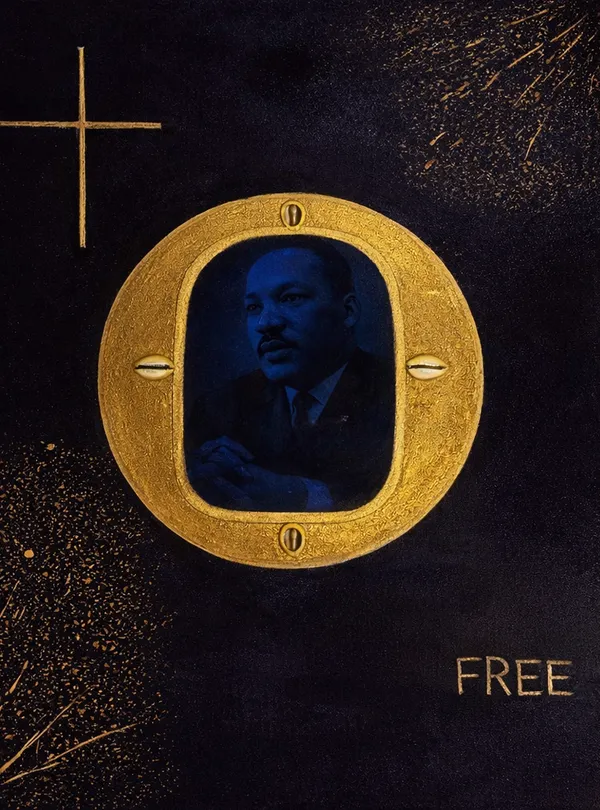
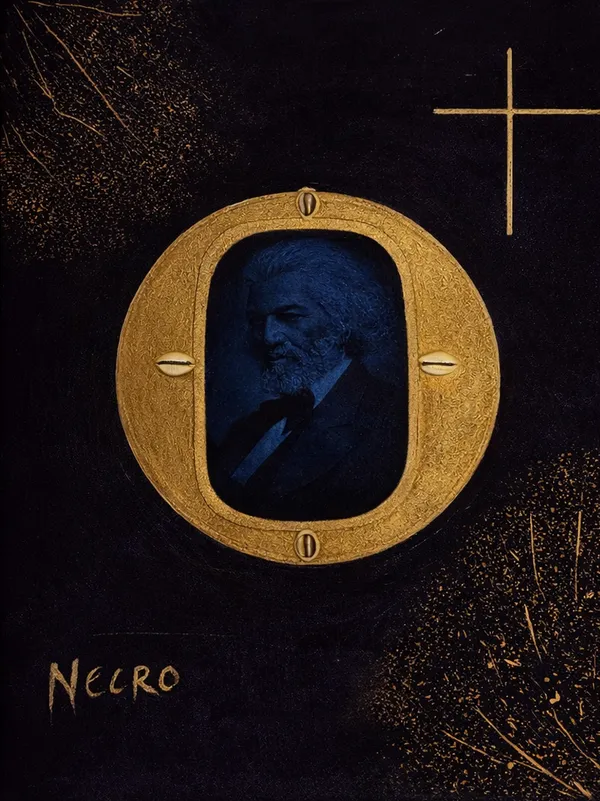
Billy Gerard Frank | Abolitionists: Cartography of Resistance and Disobedience

63.5 x 53.3 x 5.1 cm
Billy Gerard Frank's Abolitionists: Cartography of Resistance and Disobedience is a series of mixed-media works on wood panels, fabric, and canvas, rendered in natural indigo pigments, black ink, and gold. The series reimagines abolition not as a closed chapter of the nineteenth century, but as an ongoing, unfinished struggle that continues to shape the present. Drawing from the lives and legacies of Black abolitionists—both known and obscured—the works function as material palimpsests: layered surfaces in which history, erasure, and resistance coexist.
Each piece operates as a fragment of a broken archive, employing natural indigo pigments as the central medium, silkscreen, etching, transfers, gold leaf, and ink, the surfaces bear the scars of labor, displacement, and survival. Indigo, a pigment historically bound to plantation economies and the forced extraction of Black and brown labor, becomes both medium and metaphor: a residue of violence and a site of transformation. Gold, long associated with wealth accumulated through enslavement, is reclaimed here as a sign of
Black life, dignity, and spiritual endurance.
Figures such as James Baldwin, Nina Simone, and Malcolm X appear alongside earlier abolitionists like Olaudah Equiano and Phylis Wealthey, collapsing temporal distance to reveal how past struggles continue to reverberate in the present. Their presence reflects the enduring role of the artist as witness and agitator, echoing Baldwin’s insistence that “artists are here to disturb the peace.” The works ask what it means to practice this disturbance today, at a moment when Black histories are being erased, misremembered, or violently suppressed, and when Black bodies, voices, and cultural memory remain under threat.
Rather than presenting heroic portraits or fixed narratives, the series proposes an abolitionist cartography that traces how freedom has always been fugitive, relational, and incomplete.
Abolitionists: Cartography of Resistance and Disobedience insists that freedom is still becoming. Abolition is not merely the formal end of slavery, but an ongoing struggle to dismantle the afterlives of bondage, racial capitalism, carceral systems, borders, and regimes of surveillance that continue to regulate Black and brown life. The sculpted panels, with their gouged surfaces and luminous interruptions, mirror this condition: freedom is not a stable state, but a fragile, contested, and continually remade process.
In this way, the series does not simply memorialize the past; it activates it. These works invite viewers to encounter abolition not as a closed historical chapter, but as a living, unfinished project that stretches from the radical visions of enslaved rebels and Black women abolitionists to contemporary movements for justice, dignity, and collective liberation.